- Blog
・ November 25, 2026
The Influence Gap: Robert Heldt on Why Trust Closes What Content Opens in Japan and Korea
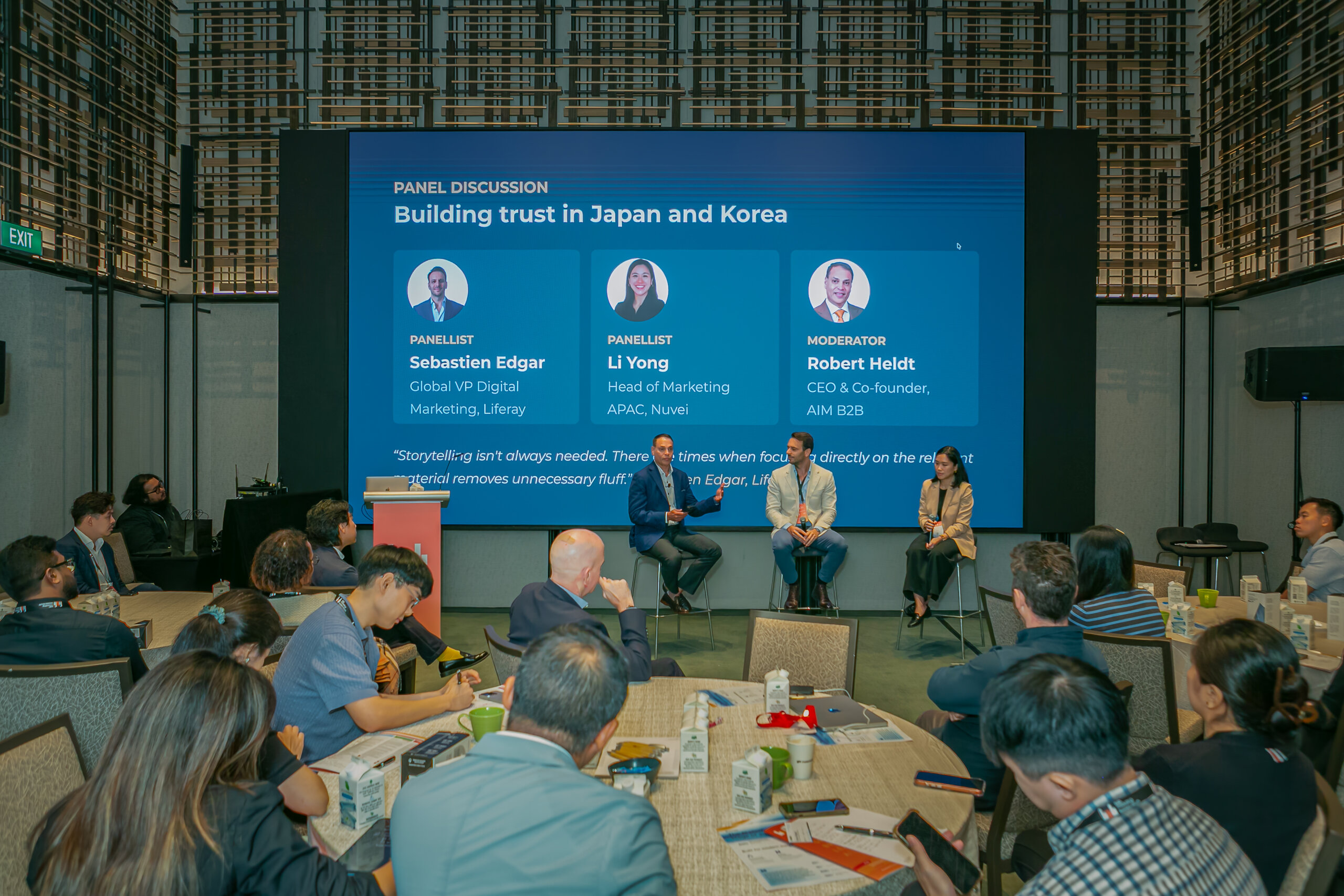
“Leaders told us they don’t trust content, then admitted they act on it.”
That was the contradiction Robert Heldt, CEO and co-founder of AIM B2B, brought to the B2B Marketing Leaders Forum ASIA in Singapore on October 15, 2026. During his session, Content, Storytelling, Trust & the Influence Gap, with a focus on Japan and Korea, Robert launched AIM B2B’s new research report, From Content to Influence. He then moderated a panel on building relationships and trust in both markets with Sebastien Edgar, Global VP Digital Marketing at Liferay, and Li Yong, Head of Marketing APAC at Nuvei.
His conclusion was straightforward: “Content works, but we keep asking it to do the wrong job and judging it on the wrong number.” For B2B marketers working in Japan and Korea, reconsidering what content is meant to accomplish may be the first step in building influence.
Why did Robert set out to test content’s role in influence?
Most marketers assume a straightforward chain of events: tell a good story, create a connection and turn that connection into influence. As the head of an agency built on B2B storytelling, Robert had every reason to believe in that process. He wanted to test it.
Between July and September 2026, AIM B2B surveyed 152 business leaders and content decision-makers in Japan and across Asia-Pacific. More than half (56%) are CEOs, managing directors or other C-suite executives, and 49% focus on the Japan market. The study examined three steps: whether content generates connections, storytelling helps turn connections into relationships and relationships ultimately create influence.
The findings support the first and last steps, but the transition from connection to relationship remains less clear. This is the gap Robert refers to as the influence gap.
Content opens doors, but what builds relationships?
The research highlights several ways content contributes to the early stages of a business relationship:
- It starts conversations: 71% of respondents have contacted or connected with someone because of a piece of content.
- It builds awareness: 72% say content creates awareness and attention.
- It signals expertise: 70% say it demonstrates expertise and credibility.
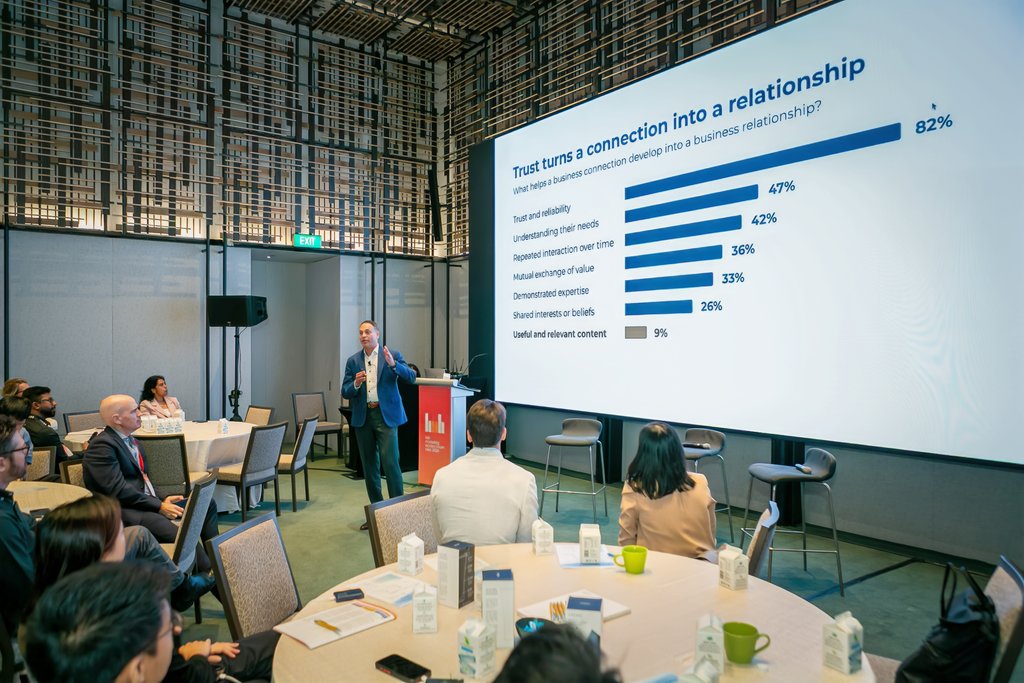
However, when asked what turns a business connection into a relationship, 82% named trust and reliability. Useful and relevant content came last, at 9%. Among those who believe good content has an effect, 71% say it changes how credible an organization seems. Only 12% say it changes what people finally decide.
“Content earns credibility,” Robert said. “People, proof and trust close the decision.”
Li Yong reinforced this point from the client side in his reflections after the panel:
“Content gets you invited into the room. People and proof move the relationship forward.” — Li Yong, Head of Marketing APAC, Nuvei
Why does content influence Japan differently?
The survey reveals a difference in how Japan-focused leaders view content’s role in influence. Only 23% call content an important source of influence, compared with 43% of respondents in regional Asia-Pacific roles and 14% in global roles. Japan-focused respondents were also the only group in which some (9%) said content has only limited influence.
Robert doesn’t interpret this as content failing in Japan. In a follow-up piece for The Drum, he argued that content matters across markets, but its role in the decision-making process can vary. Leaders focused on Japan, he wrote, tend to view content as one part of a longer process of earning credibility. On LinkedIn, he put it more sharply: “Your global B2B content strategy might be working in HQ. In Japan, it could be missing the point entirely.”
In Japanese business settings, trust (shinrai) often develops over time, with decisions shaped through nemawashi, the informal consensus-building that takes place before a formal proposal or decision. Content can support that process by giving stakeholders the information and reassurance they need as they evaluate a business partner.
Why localization requires more than translation
Localization was one of the panel’s core topics, and the research offers further insight into why it matters. Among respondents who say most content fails to influence, 50% cite a lack of distinctiveness, well ahead of competition for attention (39%). Storytelling’s impact also depends heavily on relevance to the audience (63%) and quality and authenticity (60%).
Translating a global asset is only one part of localization. Content also needs to reflect the priorities, questions and context of the people it is intended to reach.
Robert’s test for every brief is simple: could a competitor publish the same piece with their logo on it? If the answer is yes, it may struggle to make an impression. In Japan and Korea, that means:
Write for the champion: In Japan, the ringi approval process means your contact may need to present and defend your case to colleagues you may never meet. Give them a story and evidence they can share internally.
Start from local insight: Build content around what Japanese or Korean buyers need to know, rather than simply what headquarters wants to communicate.
Use local proof: Client examples, partners and data from the market can help make a case more relevant and credible than relying exclusively on global case studies.
Is storytelling still worth the investment?
For an agency built on storytelling, this was an interesting finding. When asked what makes content more effective, respondents put useful insight first (48%), ahead of credible expertise (32%) and telling a story (31%).
That doesn’t mean storytelling is no longer important. 74% of respondents still see a connection between storytelling and influence, but the findings suggest it needs to be grounded in something meaningful. Sebastien Edgar, Global VP Digital Marketing at Liferay and a contributor to the report, offered another perspective on the role of storytelling:
“Storytelling isn’t always needed. There are times when focusing directly on the relevant material removes unnecessary fluff.” — Sebastien Edgar, Global VP Digital Marketing, Liferay
Dr. Greg Story, President of Dale Carnegie Training Japan and a survey contributor, also highlighted the challenge of producing meaningful content in an era of AI: “AI makes the production of content sludge at scale cheap, fast and nasty.”
As content production becomes easier, useful insights, credible expertise and authentic stories become even more important in distinguishing one brand from another.
Are B2B companies measuring content’s impact correctly?
Most organizations judge content by the leads it produces (64%). Only 22% judge it by whether it changed perceptions, preferences or decisions. The split by role is just as telling: 25% of C-suite respondents judge content by the relationships it builds, compared with 6% of marketing and communications leaders.
“If we’re serious about building influence,” Robert wrote, “we need to look beyond the lead count.”
Lead generation remains an important measure, but it doesn’t capture everything content contributes to a relationship, particularly in markets where trust and consensus play an important role. The report outlines six practical steps for marketers looking to improve how their content builds influence:
- Ensure uniqueness: Test every brief by asking whether a competitor could publish the same piece.
- Focus on authenticity: Ground stories in real operations, clients and verifiable data.
- Maintain relationship continuity: Use content to stay visible between touchpoints and pair it with proof of business value.
- Empower internal advocates: Give champions a narrative they can take to finance and procurement.
- Establish leadership alignment: Agree on what content success means before a campaign starts.
- Track perception changes: Ask clients each quarter, “Has our published content changed how you see our company?”
FAQ
Yes, but its role in influencing business decisions may differ from other markets. Only 23% of Japan-focused leaders call content an important source of influence, and they were the only group in which some respondents said its influence was limited. Content needs to be relevant, locally grounded and part of a longer process of building credibility and trust.
Practitioners describe Korea as faster-moving and more focused on clear business value early in the conversation, while Japan places greater emphasis on patience, local credibility and consensus-building. The survey’s Korea sample is small, so these differences are best treated as practical observations rather than definitive market-level findings.
Across the survey, 82% of leaders name trust and reliability as what turns a connection into a relationship. Demonstrated business value (62%) and personal trust (58%) also feature prominently in the findings.
Among respondents who say most content fails to influence, 50% cite a lack of distinctiveness as a reason. Content developed for a global audience may not address the specific priorities or questions of buyers in Japan or Korea unless those perspectives are incorporated into the content itself.
Influence needs people
Content can help build credibility, start conversations and support business relationships, but it cannot do all of that on its own. As Robert put it, “Influence needs more than content and storytelling. It needs people.”
For B2B brands operating in Japan and Korea, the challenge isn’t simply producing more content. It’s creating content that reflects the market, demonstrates genuine expertise and gives people a reason to trust the business behind it.
AIM B2B’s teams in Tokyo, Seoul and Singapore work with global B2B brands on content developed for local markets. Download From Content to Influence to explore the full research findings and what they mean for your content strategy in Japan and Korea.
Share
Author

Category
- Professional Services
- Strategy
- Branding
- PR & Communication
- Content & Creative
Share
Latest Articles
-

- Blog
・ November 17, 2026
What to Ask a B2B Content Agency: Findings from 152 Leaders in Japan and Asia-Pacific
B2B content often informs but rarely influences. Based on findings from 152 business leaders in Japan and APAC, here are 6 questions to ask before choosing a B2B content agency.
-

- Podcast
・ November 13, 2026
Episode 17 – Digital Wisdom: What Ancient Greek Philosophy Teaches Leaders About AI, with Alfonso Asensio
Alfonso Asensio, Tokyo-based digital transformation executive and author of Digital Wisdom, explains why technology gives you information but not judgment, why saying “I don’t know” can make leaders stronger and how companies need to understand who they are before they try to transform.
-

- Blog
・ November 2, 2026
Why performance marketing alone fails global B2B brands entering Japan and APAC
Performance marketing captures demand, but it can’t create it. Robert Heldt explains why global B2B brands entering Japan and APAC should build local credibility first, with PR and marketing working from one plan.