- Podcast
・ November 13, 2026
Episode 17 – Digital Wisdom: What Ancient Greek Philosophy Teaches Leaders About AI, with Alfonso Asensio
Organizations have never had more data, more dashboards or more AI tools at their disposal. Yet many still struggle to make good decisions. For Alfonso Asensio, the reason is simple: technology gives you information, but it does not give you judgment.
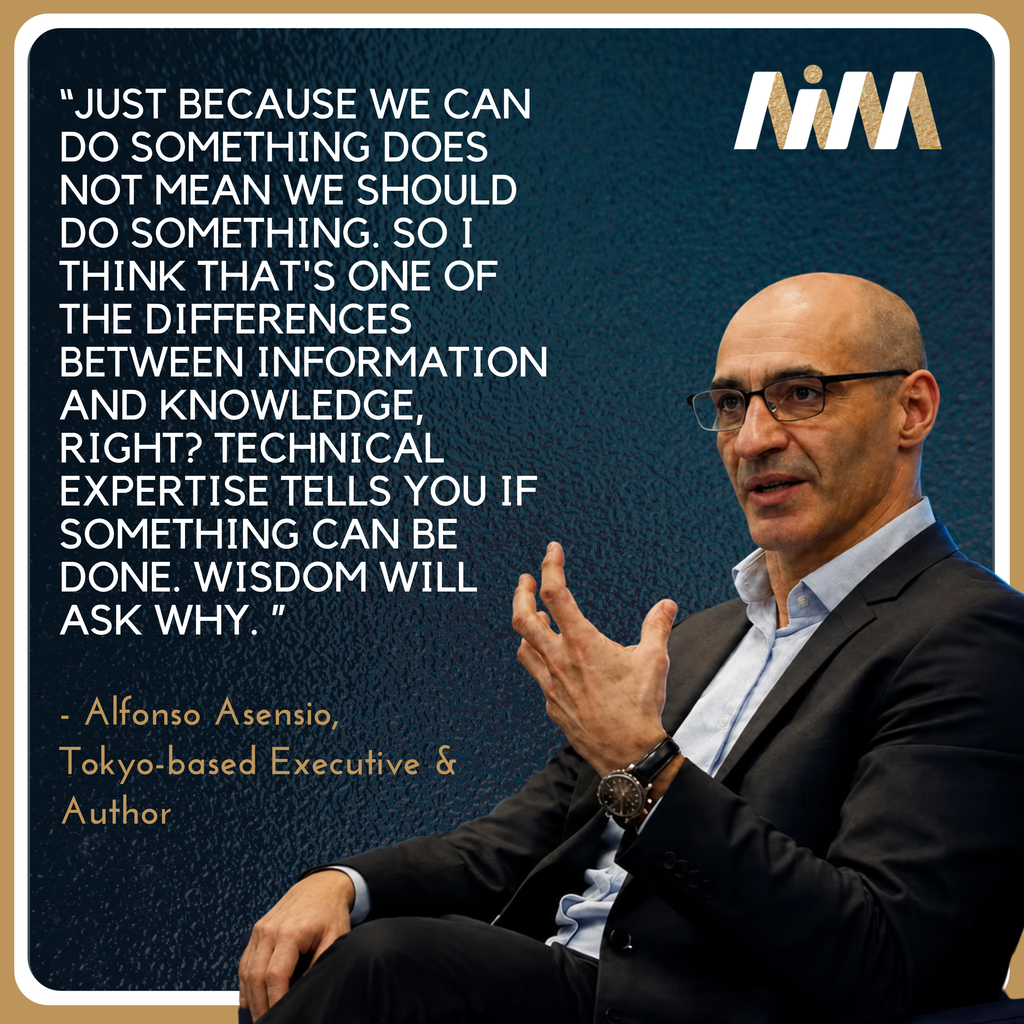
“Just because we can do something does not mean we should do something. Technical expertise tells you if something can be done. Wisdom will ask why.”
— Alfonso Asensio, digital transformation executive and author of Digital Wisdom
In Episode 17 of the Asia AIM Podcast, host Robert Heldt speaks with Alfonso Asensio, a Tokyo-based executive at a leading global company who has worked extensively in data-driven marketing and digital transformation.
Alfonso has worked on both sides of the technology divide, in business roles at large Japanese consumer-product corporations and at Silicon Valley technology companies. He is trilingual, holds a digital marketing certification from the University of California, Berkeley and a master’s degree from Nagoya University. He has presented at Rikkyo University and Hitotsubashi University in Tokyo and has lectured in digital studies at Temple University. He is the author of three books published in New York: World Wide Data (2018), Chief Kickboxing Officer (2019) and, most recently, Digital Wisdom (2025).
Rather than offering another digital transformation framework, Digital Wisdom goes back 2,500 years to ask what Socrates, Aristotle and Heraclitus might say about the problems business leaders face today. In this discussion, Alfonso explains why wisdom must guide technology, why admitting uncertainty can be a leadership strength and why companies need to understand who they are before they try to transform.
Sophia: information is not the same as judgment
Alfonso studied Greek and Latin at school, and he sees many of today’s digital-age questions as very old ones. What is real? Who are we? How do we fit in? These questions have occupied people for millennia. Technology simply makes them feel new.
In classical Greek, the word for wisdom was sophia. It meant more than wisdom as we use the term today. It included knowledge, sound judgment and practical intelligence. Modern business knowledge, by contrast, tends to be domain-specific and focused on solving immediate problems. It rarely helps leaders see the bigger picture.
Alfonso recalls a chief data officer he once worked with who often said, “Just because we can do something does not mean we should do something.” For him, that sentence captures the gap. Technical expertise tells you whether something can be done. Wisdom asks why, adding human context, ethical considerations and a long-term view.
Without that, companies can rush through a transformation and end up alienating customers or exhausting their staff. Alfonso calls the missing ingredient the Sophia Factor: the bridge between raw technical capability and real human progress.
He admits that “human-centric” can sound vague in a business setting. But he offers a simple comparison. If transportation had been designed around cars rather than people, there would be no traffic lights and no public transit. The world would be one big parking lot. Keeping people at the center of technological change is what makes it work.
Panta rhei: finding stability in constant change
Why do smart people in successful companies so often jump to technology before defining the problem? Alfonso compares it to standing on a fast-moving escalator. Step off, and someone else may take your place or your business. That fear of missing out keeps organizations in constant motion.
This feeling is not new either. The Greek philosopher Heraclitus famously said that you can never step into the same river twice, because the water keeps moving and you keep changing too. He called this panta rhei, or “everything flows.”
But Heraclitus also believed that beneath constant change there is an underlying order, which he called logos. Aligning yourself with that principle gives a sense of purpose and stability, even when everything around you moves quickly.
Alfonso’s advice to business leaders is to find their own logos: a central pillar that stays fixed while everything else changes. For many companies, that pillar could be innovation itself, because it supports continuous improvement, adaptability and long-term sustainability.
Aporia: why “I don’t know” is where wisdom begins
In many corporate cultures, leaders are expected to have the answers. Alfonso argues that admitting uncertainty can be the first step toward better decisions.
The Socratic method involved asking probing questions again and again to challenge assumptions and expose contradictions. Socrates deliberately led people into a state of confusion and puzzlement, which he called aporia. He did not see this as a failure. He saw it as a necessary stage in learning, because it forces people to question what they think they know.
The key, Alfonso says, is that this confusion must be finite. Once Socrates had brought someone to aporia, he would ask further questions to guide them toward their own conclusions, much like a modern coach or mentor.
Leadership has evolved in a similar direction. It used to be hierarchical and top-down. Today, good leaders help people reach their own conclusions, combining the classical idea of aporia with modern coaching and mentoring. At some point, of course, a leader still has to make a decision.
Alfonso points to the launch of ChatGPT as an example of the opposite instinct. Within a couple of weeks, LinkedIn was full of “AI experts” on a technology that was only two weeks old. To him, that showed a fear of saying “I should know this, but I don’t.” His view is that it is fine not to know, as long as you keep learning.
Japan, Silicon Valley and value of classics
Having worked in both large Japanese corporations and Silicon Valley companies, Alfonso sees a clear difference in approach. Japanese companies tend to focus on the process, while Silicon Valley companies focus on the result. They care less about how many hours you work or how you get there, as long as you deliver.
He believes these differences are shaped by each culture’s classical traditions: Confucian and Shinto thought in Japan, and the Greek and Roman tradition in the West. When he began working in China, the books that helped him most were not modern business titles but two 14th-century classics, Romance of the Three Kingdoms and Water Margin. They revealed something central about the country’s mentality.
His suggestion for anyone trying to understand how Japanese or Silicon Valley companies think is to look beyond business books. The Iliad, The Odyssey or The Tale of Genji may offer insights that a modern framework cannot.
Identity before transformation
One meeting in particular helped inspire Digital Wisdom. Alfonso met with a very large Japanese company that wanted to use digital technology to revamp its business. On paper, it had everything it needed: resources, talent and a sense of urgency.
But when he asked why the company wanted to become digital and where it wanted to go, the team leader answered with jargon such as “AI-driven consumer engagement” and “data-optimized performance.” Alfonso left feeling that the company was building a digital future on a foundation of buzzwords. It was chasing technology trends without understanding the underlying principles or the human impact.
The project eventually stalled. Alfonso believes the company never asked the most basic question: who are we? Not everything needs to be digital or AI-driven. Sometimes the right answer is to stay analog or to offer services offline.
He points to Blockbuster as a classic example of what happens when a company misunderstands its identity. Blockbuster saw itself as a videotape rental company. If it had seen itself as an entertainment company, for which the medium does not matter, it might have become Netflix.
Persuasion, manipulation and the Sophists
Marketers are in the business of influencing decisions, so where is the line between persuasion and manipulation? For Alfonso, the answer depends on having an ethical backbone. Technology can track consumers and generate insights, but the real question is whether it should.
He acknowledges progress over the past decade, including GDPR in Europe and the phase-out of third-party cookies, but believes there is still a long way to go as AI advances.
Once again, the debate is ancient. The Sophists were a group of Greek thinkers who saw enormous power in using words to influence people. One of them, Gorgias, became famous for a controversial defense of Helen of Troy, intended to show that words can shape reality, regardless of the ethical consequences. Socrates, Plato and Aristotle all criticized the Sophists. As Alfonso puts it, when all three heavyweights of Western thought are against you, there may be room for improvement.
He sees a direct parallel with modern data harvesting, such as the Cambridge Analytica scandal, in which personal data was used in ways people had not agreed to. The principles that should guide businesses today are the same ones that applied 2,000 years ago: transparency, consent and accountability.
Oracle and algorithm
If you are a CEO in Tokyo or Seoul with plenty of data and consultants, but no clear direction on AI, where should you start? Alfonso turns to the Oracle of Delphi.
In ancient Greece, kings and generals consulted oracles before any major undertaking, and Delphi was considered the center of the world. Seen from a secular point of view, however, the oracle had no special access to divine knowledge. It took existing information, drew new connections and offered cryptic answers that people then had to interpret. It also served to maintain the status quo.
Alfonso sees obvious parallels with today’s large language models: a black box that processes information, offers answers and may have its own agenda. The question then and now is the same. Should you trust the oracle, or look at the people behind the curtain?
His advice is to examine the motivations behind an AI system, how its models are trained, how data is used and what ethical checkpoints exist before letting it shape your decisions.
Critical thinking in the age of the algorithm
Algorithms increasingly decide what information people see, and generative AI can produce convincing content at scale. How do we decide what is true?
Alfonso has attended many corporate training programs over the years. The ones that stayed with him were not about products or specific technologies. They were about the basics: critical thinking, storytelling and communication. He believes these skills, especially critical thinking, will give people an edge both as business professionals and as consumers, because most of us are both.
Truth in the age of the algorithm, he says, comes down to judgment and discernment. That means understanding what you need to do, what the technology is doing and what impact it may have on you and those around you. When his children were younger, he showed them a video about how YouTube monetization works. His message was not to stop watching, but to understand how the system works.
What wisdom means for business leaders
For Alfonso, technology has changed the world, but it has not changed human nature. People still worry about identity, belonging and how to make sense of reality. Those questions have been asked for millennia. We are simply facing them in a new digital context.
What the Greek philosophers did was systematize the search for answers to these questions, and they called that search sophia. Their lessons are still available, ready to be picked up and applied.
Asked in the quick-fire round which philosopher every business leader should read, Alfonso chose Socrates. Asked for the most overused word in digital transformation, he answered “data.” As a self-described data person, he believes data has real value, but that businesses talk too much about data and not enough about insights.
And on how people can stay valuable as AI advances, his answer is to be as multidisciplinary as possible. In his view, people are not designed to be narrow specialists, and the ability to do many different things will help them adapt to whatever comes next.
FAQ
Digital wisdom is the idea that technology should be guided by human judgment, not just technical capability. Alfonso Asensio uses the classical Greek concept of sophia, which combines knowledge, sound judgment and practical intelligence, to argue that leaders should ask why something should be done, not only whether it can be done.
According to Alfonso, many projects stall because companies chase technology trends without defining their objectives or understanding their identity. Without a clear answer to “who are we and why do we need to change?”, a transformation can rest on buzzwords rather than real business needs.
Aporia is the state of confusion Socrates deliberately created through questioning, which he saw as the first step toward knowledge. For leaders, it means being willing to admit uncertainty, then using coaching-style questions to help teams reach their own conclusions before a decision is made.
Heraclitus taught that everything is in constant change (panta rhei), but that an underlying principle, logos, provides stability. Alfonso encourages leaders to find their own logos, a central purpose such as innovation that stays constant while technology and markets change.
Alfonso argues that an ethical backbone makes the difference. Just as Socrates, Plato and Aristotle criticized the Sophists for using words without regard for ethics, businesses today should use data and AI with transparency, consent and accountability.
Alfonso recommends developing foundational skills such as critical thinking, storytelling and communication, and becoming as multidisciplinary as possible. In his view, adaptability across different fields will matter more than narrow specialization.
Listen to the full episode
To hear Alfonso Asensio’s full insights on digital wisdom, ethical AI and what ancient Greek philosophy can teach today’s business leaders, listen to the full episode of the Asia AIM Podcast.
Share



Latest Articles
-

- Blog
・ November 2, 2026
Why performance marketing alone fails global B2B brands entering Japan and APAC
Performance marketing captures demand, but it can’t create it. Robert Heldt explains why global B2B brands entering Japan and APAC should build local credibility first, with PR and marketing working from one plan.
-

- Blog
・ October 30, 2026
Japan’s New Cybersecurity Law: 7 Questions Foreign Vendors Need to Be Ready For
Japan’s new cybersecurity law is changing how infrastructure buyers vet vendors. Here are 7 questions foreign security companies should be ready to answer.
-

- Blog
・ October 27, 2026
The SaaS Source — October 2026
Japan’s SaaS sector continues to attract strong investment, with fresh funding flowing into sales AI startup, vertical software, fintech and mortgage technology. Here’s a look at the latest startup funding and industry developments.