- Podcast
・ October 19, 2026
Episode 16 – AI Transformation in Japan: Why the Human Side Matters, with Hiromi Hara
Every week brings a new AI tool, a new breakthrough or a new prediction about the future of work. But for Hiromi Hara, Managing Director of SAP Labs Japan, the most important question in AI transformation is not what the technology can do. It is what people decide to do with it.
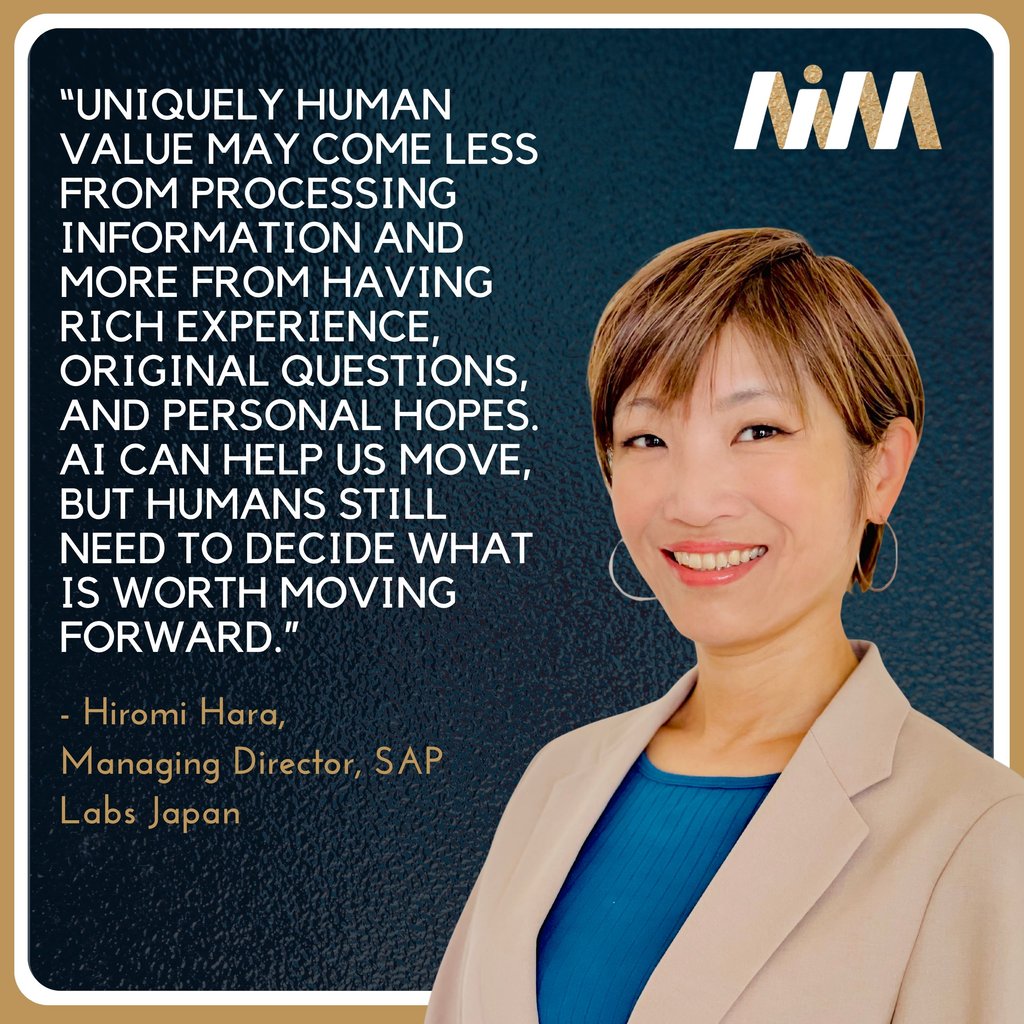
“Uniquely human value may come less from processing information and more from having rich experience, original questions and personal hopes. AI can help us move, but humans still need to decide what is worth moving forward.”
— Hiromi Hara, Managing Director, SAP Labs Japan
In Episode 16 of the Asia AIM Podcast, host Robert Heldt speaks with Hiromi Hara, Managing Director of SAP Labs Japan, where she leads product and engineering teams and helps shape customer-focused innovation.
Hiromi joined SAP Japan in 1997 and has built a career spanning software localization, integration engineering and solution consulting. In 2013, she became the regional methodology leader for design thinking and in 2018 she was appointed Head of the Innovation Office. She went on to become COO (2020), Managing Director (2021) and Executive Officer (2022) of SAP Labs Japan. She also serves on the Board of Directors of the German Chamber of Commerce and Industry in Japan (AHK Japan).
In this discussion, Hiromi explains why buying technology is not the same as transforming with it, why AI experiments confined to individual departments can create governance risk and why experienced employees need a new mindset as well as new skills.
Tsundoku: technology is the trigger, not the transformation
When asked whether technology or people drive organizational transformation, Hiromi emphasizes that both play a part. Technology alone cannot transform a company, but it can give people a compelling reason to change. As competitors adopt new tools and move faster, the competitive landscape shifts, pushing organizations to adapt or risk falling behind.
Buying technology, however, is not enough. Hiromi uses the Japanese word tsundoku, which means buying books and leaving them unread. Owning the book feels good, but nothing changes until you read it. ERP, cloud and AI work the same way. Transformation only happens when people understand the value, change how they work and stay motivated, including the many people in the middle of the organization, not only the early enthusiasts.
She also notes that people in Japan are remarkably good at coordinating without detailed instructions. That flexibility is a strength, but it can make formal digital rules feel heavy. Because AI is closer to how people naturally communicate, she sees it as an opportunity for Japan to digitize in a way that fits its strengths.
Why AI means redesigning work and how design thinking helps
Generative AI and AI agents can now take on tasks that once belonged only to people, so companies cannot simply place AI on top of existing processes. The work itself has to be redesigned. Hiromi compares this to factories where people already work alongside collaborative robots. In the office, workers will increasingly work with AI agents that draft, analyze, summarize and take action. Because these capabilities change so quickly, leaders also need to watch for transformation fatigue.
Design thinking helps on two fronts. It brings executives, business users and AI engineers together to agree where AI should be used and to design the new workflow. It also supports adoption, because the people involved understand the purpose and impact of the change. Since AI keeps evolving, Hiromi stresses that these workshops should be repeated, not held once.
The hidden risk of department-by-department AI
Hiromi’s biggest concern is that many companies adopt AI one department at a time. She understands why, since company-wide agreement is hard and painful. But an AI that learns only from one department can only become smart within that small world. It cannot support end-to-end business transformation.
She compares core business transformation to a diet app: before anything improves, it shows you the reality. Core systems and data do the same by exposing process gaps and uncomfortable performance issues. Not every team wants that visibility. Serious enterprise AI requires company-wide data and process governance, so that an AI agent knows what data it can access, what it is allowed to do and how its answers should change depending on who is asking.
Leading teams of humans and AI
Hiromi believes leaders will increasingly manage teams made up of both people and AI. Motivation, trust and communication still matter, but leaders will also need to think about AI’s cost, performance and data. They also need to agree on those rules across the company rather than within one department. Japanese organizations often excel at optimizing work inside a department but find cross-department standards harder, so leaders need to notice where departmental walls are blocking progress and connect the right people.
Culture is equally important and Hiromi stresses that it has to be backed by practical change management:
- Communicate clearly about why and how AI is being introduced
- Provide learning opportunities and support study communities
- Create AI champions in each department
- Encourage colleagues to share what has worked for them, rather than relying only on top-down messages
As one leader she worked with often said, “culture eats strategy for breakfast.” If departments hide their data, even the most powerful AI will not be used the right way.
Reskilling is not enough: the case for “remindset”
For experienced employees, Hiromi argues, reskilling is not enough. They also need a “remindset”: the willingness to become a beginner again.
AI gives Japanese organizations an opportunity to modernize legacy systems and improve productivity as the working-age population continues to shrink. According to the Statistics Bureau of Japan, the working-age population declined from approximately 87.16 million in 1995 to 73.73 million in 2024, a decrease of more than 13 million people.
However, AI adoption also brings new challenges, particularly in employee development. Junior employees have traditionally built their skills and business knowledge through hands-on, task-level work. As AI increasingly takes over these responsibilities, companies must rethink how they train and develop the next generation of professionals.
Experienced employees face the second challenge. The more experience people have, the harder it can be to become a beginner again. Experience does not become useless, though. It becomes the foundation for judging whether AI’s output is realistic, responsible and right for the business.
Ultimately, Hiromi believes humans still decide the destination. Even a robot taxi will not go anywhere until someone says where to go. AI can help us think, but it cannot replace our responsibility to choose. When asked what quality AI will never replace, she chooses the Japanese word mendoumi: willingly taking care of someone even when it takes time and effort.
FAQ
AI can take over tasks that once only people could do, so companies need to redesign how work is done rather than adding AI to existing processes. That requires people to understand the value of AI, change how they work and stay motivated. Technology can trigger transformation, but people determine whether it happens.
Tsundoku is a Japanese word for buying books and leaving them unread. Hiromi uses it to describe companies that buy AI, cloud or ERP licenses without changing how they work. Owning the technology can feel like progress, but transformation only happens when people use it to work differently.
Design thinking brings executives, business users and AI engineers together to agree where AI should be used and to design new workflows. It also supports change management, because the people involved understand the purpose of the change. Because AI evolves quickly, these sessions should be repeated rather than run once.
AI that learns from only one department can help with narrow tasks but cannot support end-to-end transformation. Isolated experiments also make it harder to control which data AI can access and what actions it can take, which creates governance risk.
“Remindset” is Hiromi’s term for the mindset shift experienced employees need alongside reskilling. It means being open to becoming a beginner again and using experience to judge whether AI’s output is realistic, responsible and right for the business.
Listen to the full episode
To hear Hiromi Hara’s full insights on AI transformation, leading teams of humans and AI and why human judgment matters more than ever, listen to the full episode of the Asia AIM Podcast.