- Podcast
・ July 17, 2026
Episode 13 – Decoding the Hidden Rules of Japanese Business with Richard Mort
Most European companies still treat Japan like a trade show problem. Book a booth, have good meetings and close some deals. That approach is why so many of them leave empty-handed.
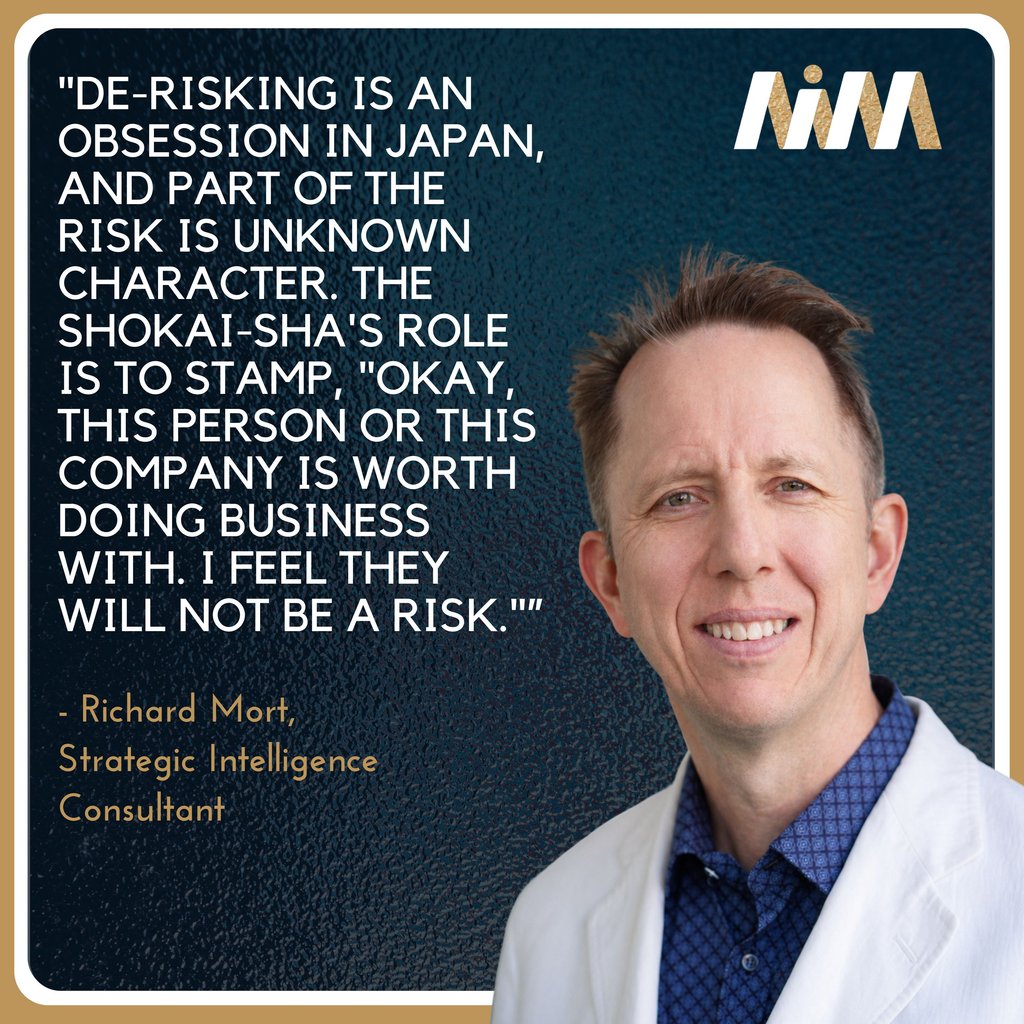
“De-risking is an obsession in Japan and part of the risk is unknown character. The Shokai-Sha’s role is to stamp, ‘Okay, this person or this company is worth doing business with. I feel they will not be a risk.’”
— Richard Mort, Strategic Intelligence Consultant and Interpreter
In Episode 13 of the Asia AIM Podcast, host Robert Heldt speaks with Richard Mort, a British strategic intelligence consultant and interpreter who spent 24 years living and working in Japan and Singapore. He now runs The Human API from Düsseldorf, a city home to more than 500 Japanese companies, and has spent years forensically mapping trade shows, startup ecosystems, and business networks on both sides of the Japan-Europe corridor. From this unique vantage point, he has a front-row seat to why deals stall, trust breaks down and cultural signals get missed in both directions.
What emerges is not a checklist of etiquette tips, but a picture of an entire parallel business world, one built on patience, unspoken signals and relationships that form long before anyone mentions a contract.
Why do European companies keep misreading the Japanese sales cycle?
The most common mistake Richard sees is companies treating Japan as an untapped economic engine ready to be unlocked at a trade show. Meetings happen easily enough. Deals do not. If a deal happens at all, it typically lands six to nine months after that first meeting and for many European companies that timeline is simply too long to tolerate.
Richard’s view is that once a person’s Japanese reaches a genuinely proficient level, the additional effort should shift almost entirely to cultural fluency, not vocabulary. Doors open when people take a real interest in who they’re meeting: where someone is from, what their town is known for, what they care about outside the deal. That effort, he says, is never wasted.
He offered a personal example from a recent interpreting job: a Japanese manufacturing team visiting from Iwate Prefecture noticed that he stayed on his feet for the entire trade show shift rather than sitting when the booth was quiet. It was a small thing by European standards. In Japan, it is registered as a sign of character.
How does business networking actually work in a country where almost no one uses LinkedIn?
Richard’s most-read article, “How Japan Links In (Without LinkedIn),” came from a simple observation: only around 4-5% of the Japanese workforce uses LinkedIn, yet Japan remains one of the world’s largest economies. That means an entire relationship-building infrastructure exists outside the platform most European businesspeople default to.
Physical business cards, meishi, are still close to mandatory at Japanese corporate events. Apps such as Eight by Sansan digitize that exchange, scanning paper cards into a database and automatically updating contact details when someone changes roles. Facebook, largely dormant for European professionals, still functions as an active networking tool in Japan through specialist groups.
For a European company trying to reach Japanese buyers, Richard’s advice is to work through the hundreds of Japanese subsidiaries already operating in Europe or through trusted intermediaries such as Japan External Trade Organization (JETRO), chambers of commerce and industry organizations. In Japanese business culture, this role has a name, the shokai-sha, the introducer whose endorsement functions as a stamp of approval. Without that stamp, Richard says, de-risking an unknown counterpart is close to impossible.
What is nemawashi actually doing behind the scenes?
Real decision-making in Japan rarely happens in the meeting itself. Richard describes nemawashi as a process of consensus-building that runs through a much wider network than the people sitting at the table, sometimes including former executives or people connected to a company in indirect ways. Much of it unfolds through conversations that don’t look like business at all: small talk about tennis, football or a recent trip, stretched across an entire meeting.
That small talk is not filler. It’s the trust ritual itself. Richard’s read is that character judgment matters more in Japan than almost anywhere else he has worked; the shokai-sha‘s implicit role is to signal that a person or company carries acceptable risk.
Once nemawashi has done its work internally, the ringi system formalizes it: a document circulates for approval from each relevant decision-maker before anything moves forward. Richard estimates this process typically takes six to twelve months, a timeline he considers almost unique to Japan.
Where does the cultural gap run the other way, from Japan into Europe?
Japanese companies operating in Germany face their own blind spots. Richard described a case where a Japanese manager, new to running a German office, was blindsided by local staff arriving a few minutes late without the elaborate apology that lateness demands in Japan. The same gap shows up around working hours: staying well past five o’clock is unremarkable in Japan, while German staff tend to treat the end of the contracted day as a hard boundary.
Richard also flagged a mismatch in reputations. Germany’s precision is legendary in manufacturing, yet its train network runs late roughly half the time, with delays inside nine minutes not even officially counted as late. Compare that to Japan’s rail network, where the average delay across the entire system is under a minute. The gap between reputation and reality, in both directions, is something both sides have to unlearn.
What did a real trade show misread teach Richard about his own blind spots?
Richard was candid about a recent miscalculation with a mid-sized company from Osaka. Weeks of preparation went into it: pre-show emails, a Zoom call, detailed research into the product and market. The meeting itself was cordial. But in hindsight, he believes the company agreed to meet out of politeness rather than genuine buying interest, a distinction that even someone with decades in Japan can miss.
It’s a live illustration of tatemae and honne, the gap between the face someone presents and what they actually feel. Richard connects it to his early years in Japan, when a warm conversation and an exchange of contact details felt like the start of a friendship. Experience has taught him that pleasant and superficial can look identical in the moment and that no shortcut exists for developing the radar to tell them apart.
FAQ
Trust in Japanese business is built through consensus (nemawashi) and formal internal approval (ringi), both of which take time by design. A first meeting rarely leads directly to a deal; it starts a longer internal process that can’t be compressed.
Through subsidiaries, JETRO offices, chambers of commerce and trusted intermediaries known as shokai-sha. Physical meishi exchange and apps like Eight by Sansan remain central to how Japanese professionals actually connect.
Nemawashi is the informal, relationship-driven consensus-building that happens before a decision, often through conversations that don’t look like business at all. Ringi is the formal approval process that follows, where a document circulates for sign-off from each relevant stakeholder.
Tatemae is the face or position someone presents; honne is what they actually think or feel. A warm, enthusiastic meeting can still mask an absence of real buying intent and even experienced foreign professionals can misread the difference.
Prepare culture before language and expect to do forensic research well beyond a company website, including video and interviews in Japanese, since most Japanese companies and executives are not discoverable through LinkedIn.
Listen to the full episode
To hear Richard Mort’s full conversation with Robert Heldt on trade show strategy, nemawashi, business networking without LinkedIn and building cross-cultural trust between Japan and Europe, listen to the full episode of the Asia AIM Podcast.
Share


Latest Articles
-

- Podcast
・ October 19, 2026
Episode 16 – AI Transformation in Japan: Why the Human Side Matters, with Hiromi Hara
-

-