- Podcast
・ June 18, 2026
Episode 12 – Marketing Transformation in the AI Era: Storytelling, Trust, and Leadership with Dr. Laura Bonamici
Most organizations treat marketing as a support function. That assumption is now a strategic liability.
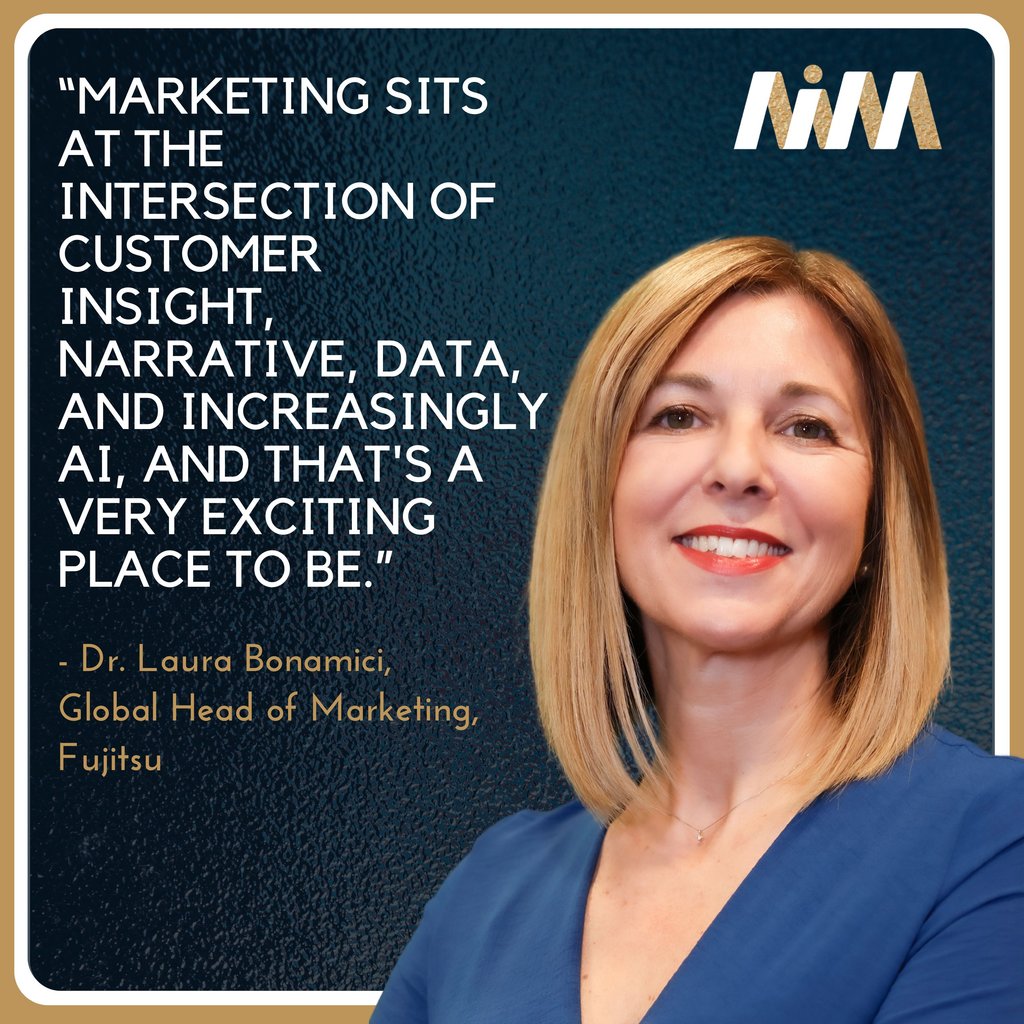
“Marketing sits at the intersection of customer insight, narrative, data and increasingly, AI. That’s a very exciting place to be.”
— Dr. Laura Bonamici, Global Head of Marketing at Fujitsu
In Episode 12 of the Asia AIM Podcast, host Robert Heldt speaks with Dr. Laura Bonamici, former Senior Vice President and Global Head of Marketing at Fujitsu. Laura argues that marketing today sits at the intersection of customer insight, data, narrative and AI, and that most organizations are dramatically underusing that mandate to drive enterprise-wide transformation.
What emerges from the conversation is not a set of tactics, but a reframing of marketing itself: as a transformation system, a cultural force, and a leadership discipline.
Why is transformation more cultural than technological, and what does marketing have to do with it?
When Fujitsu’s new CEO took the helm in 2019, the transformation he initiated was deliberately holistic: business model, technology portfolio, customer engagement and people, all simultaneously. Laura describes the journey as built on three interconnected areas: purpose, data and AI. The order matters. Purpose came first.
Laura is direct about why so many transformation programs stall. They fail not on strategy and not on execution, but on translation, the gap between a compelling idea and the behaviors it was supposed to produce. For transformation to take hold, people must not just understand the direction, they must believe it, remember it and act on it.
In this framing, marketing stops being the function that communicates transformation after it is defined. Instead, it becomes part of how transformation is designed in the first place.
Marketing’s role, Laura argues, is to define the strategic narrative, align leadership, and influence how sales teams sell, how employees show up and how the organisation behaves across every touchpoint. In other words, marketing becomes the system through which transformation becomes legible and actionable.
How do you lead for change across cultures and language barriers, especially in Japan?
Laura arrived in Japan in 2022 with ten years at Fujitsu and 37 prior visits behind her. It still reset her assumptions. In an environment shaped by nemawashi (consensus-building) and indirect communication, she learned quickly that having the right answers was not the point. Creating conditions where others could contribute was.
One of the most revealing decisions she made was reframing English not as a foreign-language burden but as a shared marketing capability. The rationale was practical: if the team could not fully participate in a global conversation, they could not do marketing at the level the role required.
The effect was unexpected. Language fluency did not track seniority. Junior team members were often the most confident English speakers, and shifting the focus from who was speaking to what was being said elevated voices that had previously gone unheard.
Laura frames this as an example of cross-cultural intelligence as a leadership discipline. It requires questioning assumptions that feel like facts, tolerating ambiguity and leading with what she describes as “radical curiosity”: not passive openness, but an active, structured commitment to being wrong.
What does storytelling actually do that data and strategy cannot?
Laura holds a PhD in drama and theater studies, with a focus on digital technologies and storytelling. She is careful to separate stories from storytelling. Stories are everywhere, in customer wins, product breakthroughs and team failures. Storytelling is the discipline of making those moments land, of creating emotional clarity even when linguistic clarity is still catching up.
Her central insight is that understanding is not enough. Memory drives action.
Data and statistics can be understood in the moment and forgotten by the afternoon. A story, when it lands emotionally, is what someone carries into the next meeting, the next decision or the next conversation with a colleague. In cross-cultural environments, where meaning is often partially lost in translation, storytelling becomes less an ornament and more an operational bridge.
For marketing leaders facing an AI-flooded content landscape, Laura’s prescription is clear: start with purpose, not a prompt. Without a grounded sense of what a brand stands for, AI-generated content risks becoming competent, coherent, and indistinguishable from everything else.
Where is AI genuinely changing marketing, and where is it overhyped?
Laura is measured about AI. She sees genuine value in what she calls accelerating exploration, the ability to research, test and iterate at a pace that was previously impossible. But she is skeptical of framing AI as primarily a volume engine.
The more significant shift is organisational. AI creates space for more strategic thinking, but that space is unfamiliar to teams trained on tight production cycles and defined deliverables. A key leadership challenge now is helping teams understand what they still bring that AI does not, and how to lean into it.
She also identifies clear signals that AI is being misused in marketing teams:
- Prompting before briefing: content goes out without a clear articulation of what the brand stands for, resulting in output that sounds polished but says nothing distinctive
- Measuring volume over meaning: publishing cadence increases while audience engagement and message retention decline
- AI as an arbitrator: human judgment is bypassed rather than informed, particularly in decisions involving cultural nuance, brand risk or audience empathy
- Soft skills deprioritized: as AI absorbs structured tasks, the capabilities that actually differentiate, adaptability, creative thinking and reading the room, are treated as secondary
In her view, AI is not removing the need for judgment. It is making judgment more visible.
FAQ
She means it literally: marketing should be in the room where strategy is designed, not brought in afterwards to communicate it. At Fujitsu, the marketing function was responsible for making the company’s transformation understandable, desirable and actionable, internally as much as externally. That is a fundamentally different role than campaign execution.
Laura’s experience points to three things: strategic clarity that simplifies rather than obscures, genuine psychological safety for junior and non-native-English speakers and what she calls radical curiosity, or the discipline of treating your own assumptions as hypotheses. In Japan specifically, where ringi (the formal approval process) and indirect communication shape team dynamics, trust is built through consistency and respect, not speed.
Stories are raw material. Storytelling is the skill of selecting, shaping and delivering them so they produce a specific effect — alignment, belief, action. Laura’s point is that memory, not understanding, drives behaviour. A story is what closes that gap.
Laura’s view: we are just getting started. But the hype is concentrated in the wrong place. AI as a content factory is an incremental gain. The real opportunity, and the harder shift, is in freeing up human capacity for the judgment, creativity and strategic thinking that AI cannot replicate.
Radical curiosity. In a world where AI surfaces answers instantly, the competitive advantage shifts to those who ask better questions, who probe, test, challenge and refuse to default to the logic of the past. Laura frames it not as a personality trait but as a leadership practice.
Listen to the full episode
To hear all of Laura’s insights on marketing transformation, storytelling and AI-era leadership, listen to the full episode of the Asia AIM Podcast with host Robert Heldt.